Real-Time vs. Post-Deposition Analysis: Why Timing Changes Everything
In high-stakes depositions, a single missed contradiction can reshape a case. Real-time analysis gives litigation teams the ability to cross-check testimony as it unfolds, follow up under oath, and carry those insights into post-deposition review.


The Cost of Realizing Too Late
Every litigator has experienced it: You finish a deposition on Monday. By the end of the week, the transcript arrives. You sit down to review it, page by page, and somewhere inevitably near page 187, there it is: a contradiction. But now the witness is no longer under oath, and your window to follow up has closed.
Traditional deposition workflows are built around this delay: testimony comes first and analysis later. Then strategy adjusts after the record is fixed. Even as AI deposition tools have entered workflows, most still operate within this same sequence. They may speed up summarization, but they do so after the fact.
And in this arena, timing is everything. Insight discovered after a deposition documents what happened. Insight discovered during a deposition can change what happens next.
The Post-Deposition Analysis Workflow
Traditionally, litigation teams review depositions only after they conclude, following a familiar—but time-intensive—workflow:
- The transcript is delivered.
- Attorneys and litigation teams review and annotate.
- Testimony is cross-referenced against prior depositions and case documents.
- AI tools, if used, generate summaries or issue outlines.
- Litigation teams refine strategy based on what that review reveals.
Research from firms like Baer Reed highlights how important transcript review is for shaping trial themes and preparing expert witnesses. Traditionally this process is as labor intensive as it is methodical, with litigation teams spending hours organizing testimony, annotating key passages, and highlighting transcripts. As the field evolves, more attorneys are taking advantage of deposition technology to streamline this process. As Nicole Black explains in the ABA Journal,
“Another technology tool designed to streamline the litigation process is deposition review software, which assists lawyers with the typically tedious process of reading, reviewing, and annotating deposition transcripts during the pretrial process. These programs enable paperless depositions by storing digital transcripts in the cloud, which are then accessible from any compatible device.”
Even with modern AI deposition tools speeding up transcript review, the insight still comes after the fact. By the time contradictions surface, the deposition is already over. At that point, the focus shifts to documenting what happened rather than adjusting strategy in real time.
CheckMate: Redefining Deposition Analysis From Live Testimony to Post-Deposition Insight
A new generation of deposition technology is beginning to close that gap. Prevail’s CheckMate brings real-time testimony verification and analysis directly into the deposition workflow, allowing litigation teams to analyze testimony as it happens, all while preserving the full power of post-deposition review.
Designed to support attorneys without disrupting their focus, CheckMate enables attorneys to flag testimony and collaborate with colleagues during the proceeding itself, then continue that analysis afterward within the same secure workspace. Transcripts, notes, and video clips remain connected in a searchable testimony library, allowing legal teams to build on insights captured during the deposition rather than starting their review from scratch.
In other words, the traditional workflow isn’t replaced; it’s expanded. Instead of waiting for the deposition to end before meaningful analysis begins, legal teams can carry insights forward from the moment testimony is given through the entire post-deposition review process.
With capabilities like these, CheckMate ushers in a new era of deposition analysis, where insights captured during live testimony continue to inform strategy long after the session concludes.
What Real-Time Analysis Makes Possible
The real shift occurs when litigation teams move analysis from after the deposition to during it, cross-checking testimony in real time, surfacing overlooked details, and adjusting questioning strategy while it still matters. Instead of waiting hours or days for a transcript to arrive and be reviewed, live transcription can now feed directly into real-time deposition analysis while testimony is unfolding in the moment.
Imagine a witness mentions a contract clause while answering a question. With live AI analysis, the legal team can instantly check that against past depositions and related documents. If a contradiction pops up, the attorney can follow up right away, while the witness is still testifying, instead of waiting until later.
Reducing the Cognitive Load of Task Switching
Depositions already demand constant attention. Attorneys are listening carefully to testimony, planning the next line of questioning, and often toggling between apps to coordinate with their team. When that work requires switching between transcripts, notes, and messaging platforms, it’s easy for attention to fragment and lose momentum in the moment. In a setting where strategy evolves minute by minute, minimizing those interruptions can be game-changing.
Advancing the Next Generation of Deposition Technology
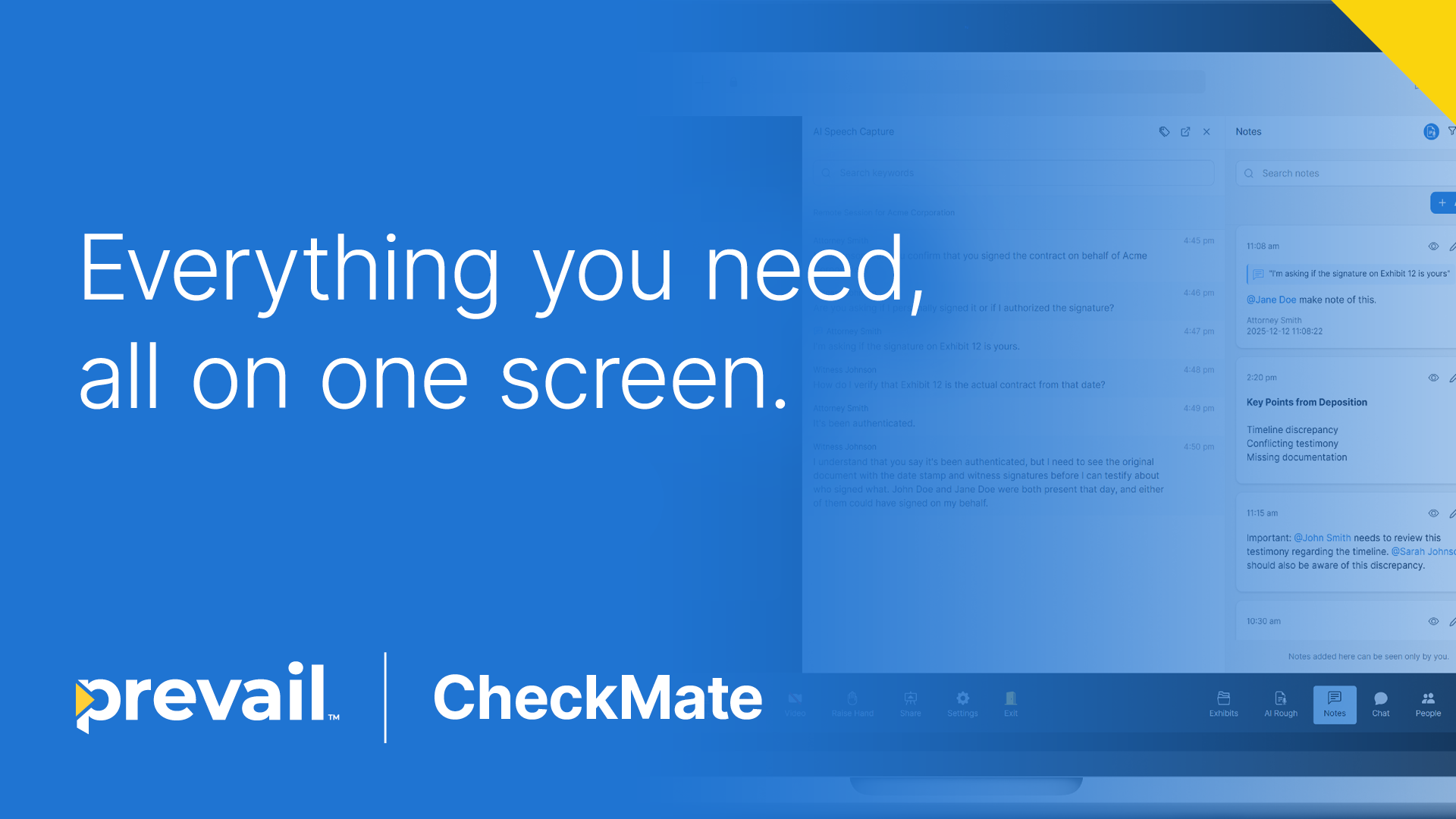
By bringing real-time transcription, team collaboration, and AI-powered analysis into a single unified platform, CheckMate allows attorneys to remain fully present during questioning while critical insights surface alongside the live transcript.
CheckMate streams live transcripts with accurate speaker identification while enabling teams to take collaborative notes and organize observations as testimony develops. Those transcripts and notes flow into a firm’s preferred systems, enabling AI-powered deposition analysis and empowering legal teams to identify critical moments as they occur.
The result is a more connected workflow that supports both in-person proceedings and remote or virtual depositions. By keeping testimony, notes, and analysis within a single environment, attorneys gain immediate visibility into developing testimony without interrupting the flow of questioning.
The goal is not to introduce another deposition tool into an already complex process. Instead, CheckMate reduces operational friction by consolidating essential deposition technology into one workflow, allowing attorneys to stay focused on the witness and maintain command of their strategy as they adapt and respond in real time.
Team Collaboration Changes Too
Depositions are rarely solo projects. Teams include associates, paralegals tracking exhibits, and often remote participants observing proceedings. Traditionally, collaboration happens through what some call the hidden language of depositions: whispered sidebars, passed notes, or post-deposition debriefs. Analysis often comes after the fact, leaving attorneys juggling multiple streams of information while trying to stay present with the witness.
Even subtle cues, like a shift in tone, can reveal important information. Experienced attorneys know these nonverbal signals can speak volumes more than words alone. But parsing them in real time is challenging when you’re bogged down toggling between apps and documents.
That’s where CheckMate revolutionizes the deposition process: The full team can see the live transcript simultaneously and share insights without interrupting the examination. If multitasking diminishes attention to nuance, instant transcription and real-time session review give attorneys the mental space to notice microexpressions or shifts in tone that could be otherwise missed. This real-time capability does more than improve efficiency: it changes how teams approach depositions. Depositions are no longer just information-gathering exercises; they become dynamic, collaborative opportunities to shape case strategy while testimony is happening, letting attorneys act on insight instead of waiting for the record to close.
High-Impact Scenarios in Deposition Technology and Virtual Depositions
The impact of real-time deposition analysis stands out in high-stakes contexts, where every moment counts. CheckMate changes the game by embedding AI directly into the workflow, consolidating transcription, collaboration, and analysis in a single platform. Attorneys can act on testimony in real time, turning the deposition room into a space for immediate insight and strategic advantage.
Multi-Day Depositions
On day three of a multi-day deposition, a witness references the June restructuring timeline, claiming the board approved the plan “sometime in early April.” Litigation Support asks CheckMate when the witness claimed the board reviewed the plan in previous testimony, immediately surfacing a contradiction against statements from day one, where the same witness said the board did not see the plan until May. Rather than pausing or flipping through binders, attorneys can follow up in real time while the witness is still under oath. What would have been a delayed discovery in a traditional workflow becomes an immediate strategic opportunity.
Single-Opportunity Witnesses
When executives or key decision-makers are only available once, delayed analysis risks lost leverage. As a CEO references a 2019 internal communication, the examining counsel queries against discovery materials, and CheckMate surfaces the relevant board resolution in real time. Attorneys see contradictions and follow up instantly, under oath, rather than documenting a “might-have-been” for post-deposition review. This capability is especially powerful in virtual depositions or remote depositions, where access and follow-up are limited.
Document-Heavy Cases
In cases involving thousands of documents, AI deposition tools remove reliance on memory alone. When a witness cites a sub-clause in a vendor agreement, requests in the CheckMate interface instantly surface the correct document alongside the live transcript. Attorneys can verify testimony, adjust questioning, and maintain control of the narrative without interrupting the flow. Real-time AI testimony verification and analysis ensures key inconsistencies or critical details are never missed, even in the most document-intensive matters.
By consolidating transcription, collaboration, and AI-powered analysis in a single deposition tool, innovations like CheckMate transform the deposition room from a reactive information-gathering space into a proactive, strategic environment—whether in-person, remote, or virtual. Real-time deposition analysis turns insights into immediate action, giving legal teams unprecedented control, accuracy, and efficiency.
Evaluation Criteria for Legal Teams
As law firms and enterprise legal departments evaluate real-time deposition platforms, key considerations include:
- Seamless functionality across in-person, hybrid, and fully remote depositions
- Accurate speaker identification to support reliable AI analysis
- Integration with existing LLMs or firm-specific systems
- Collaboration capabilities for the entire team in a single workspace
- Enterprise-grade security standards, such as SOC 2 Type 2 and ISO 27001
- Reduction of context switching rather than introduction of additional tools
According to the ABA Legal Industry Report 2025, 43% of professionals prioritize integration with existing software. CheckMate was built to meet that need, bringing secure collaboration and efficient workflows into one unified ecosystem—so attorneys can preserve strategic options when it matters most: during live testimony.
Depositions Are Catching Up
Return to that moment on page 187. In a traditional workflow, the inconsistency becomes a note, perhaps a trial exhibit or motion. In a real-time workflow powered by CheckMate, it becomes an immediate follow-up question, clarified under oath and preserved in context.
Depositions are among the most consequential events in litigation, yet their analytical layer has lagged behind the broader legal technology stack. That gap is closing. Real-time deposition analysis, AI testimony verification and analysis, and modern deposition technology are transforming documentation into actionable leverage. Firms that integrate these capabilities into their deposition strategy, whether for virtual depositions or in-person proceedings, don’t just review transcripts faster. They can conduct depositions differently, transforming routine testimony into real-time strategic advantage.
Real-time deposition analysis is here. See CheckMate in action.